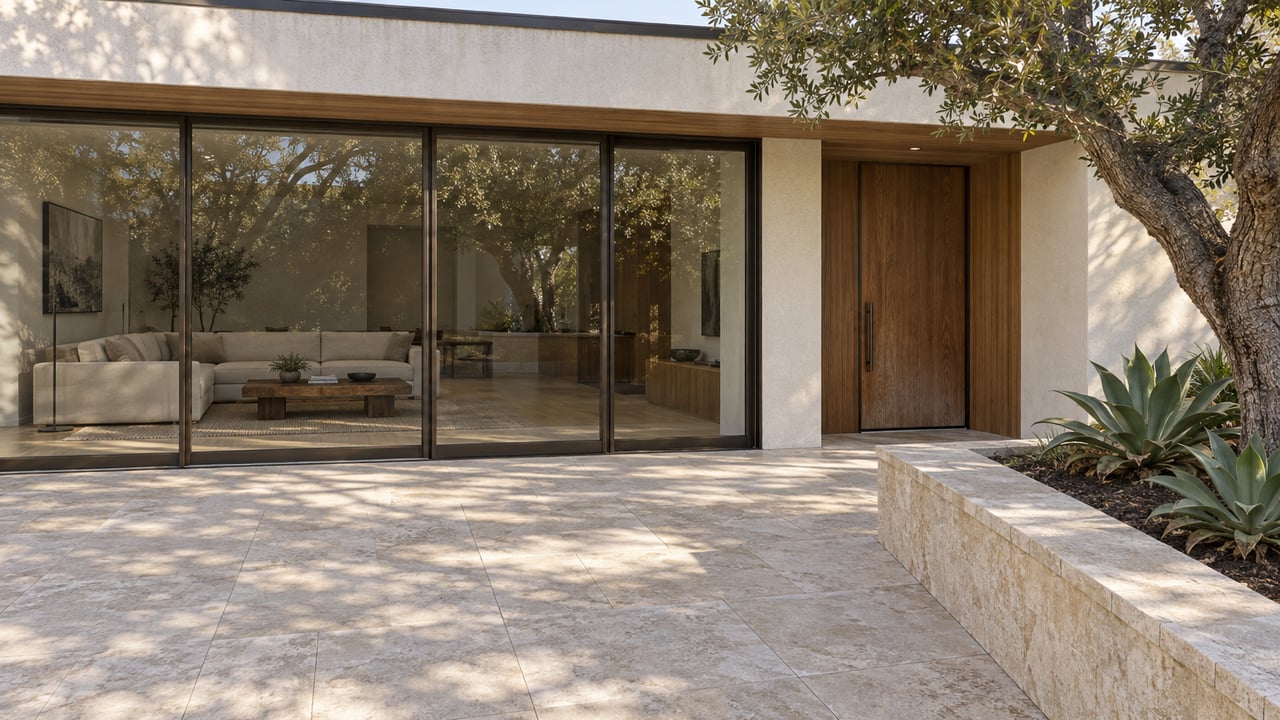
A 1940s stucco-and-stone house on Torreyson Drive, high above Mulholland, came to market in May 2025 at nearly $7 million. It was later relisted at $6.4 million. At the end of August 2026 it closed at $5.385 million, as Robb Report reported. The listing included three-quarters of an acre, about 4,600 square feet, a guesthouse, and views across Mulholland and Laurel canyons.
The closing price landed $15,000 below $5.4 million. That number is the threshold for Los Angeles's Measure ULA transfer tax for sales closing after June 30, 2026. In the Hollywood Hills, a sale near that line often ends there because it was priced against the line, not because a buyer and seller met somewhere in the middle.
What $15,000 is actually worth
The City of Los Angeles charges a base transfer tax of 0.45% on every sale. Measure ULA adds 4% once the price passes $5.4 million and 5.5% at $10.9 million or more. The city's Office of Finance applies the ULA rate to the whole price, not just the portion above the threshold. One dollar over the line triggers tax on all of it.
Run the Torreyson Drive price, and a price slightly above it, through the city's published rates:
| Sale price | Base tax at 0.45% | ULA tax | Total city transfer tax | Price minus city tax |
|---|---|---|---|---|
| $5,385,000 | $24,233 | $0 | $24,233 | $5,360,767 |
| $5,410,000 | $24,345 | $216,400 | $240,745 | $5,169,255 |
| About $5,610,000 | $25,245 | $224,400 | $249,645 | About $5,360,355 |
A buyer paying $25,000 more creates about $216,000 more in city tax. At $5.41 million, the proceeds after city transfer tax come out roughly $191,500 lower than at $5.385 million. The figures cover city transfer tax only. Commissions, county charges, and everything else that comes out of a closing are left out.
The real gap runs from $5.4 to $5.6 million
The last row of the table matters most for pricing. Proceeds after city transfer tax only get back to the $5.385 million level at a price of about $5.61 million. Between $5.4 million and roughly $5.6 million, every sale leaves the seller with less than a sale just under the line would have.
Buyers don't cover that cost. Emil Hartoonian of The Agency told The Real Deal in July 2026 that "buyers generally do not assign additional value to a property simply because the seller has a substantial ULA obligation." A house that appraises like its neighbors at $5.5 million doesn't become worth $5.61 million to a buyer because the tax schedule says it should.
So a house valued in that range has two realistic outcomes. It closes below the line, or it doesn't trade at all. The research shows both.
UCLA Anderson researcher Yingru Pan studied the city's first years under ULA, when the line was still $5 million. In her July 2025 working paper, she found that residential sales clustered at $4.95 million to $5.0 million. That price band had 47% more transactions than the first band above the threshold. After the tax took effect, the $4 million to $5 million band recorded three to five times as many monthly sales as the $5 million to $6 million band. Researchers at the UCLA Lewis Center reported in April 2025 that the odds of a city property selling above a ULA threshold fell by as much as 50%. Not all of this research is settled. A September 2025 critique led by Occidental College argued that separate Lewis Center reports relied on short comparison periods and a limited control sample. That critique focused mainly on the multifamily production estimate.
The Torreyson Drive sale fits Pan's pattern, just with a bigger line.
The threshold moves every July
ULA's thresholds rise each year with the Bureau of Labor Statistics Chained Consumer Price Index. So far the line has moved like this:
- April 1, 2023: the tax takes effect at $5 million and $10 million
- July 1, 2024: $5.15 million and $10.3 million
- July 1, 2025: $5.3 million and $10.6 million
- Sales closing after June 30, 2026: $5.4 million and $10.9 million
That makes the closing date part of the price. At $5.385 million, the Torreyson Drive sale would have been $85,000 over the line under the July 2025 threshold. At 4%, the ULA portion alone would have come to about $215,400. Closing at the end of August put the same price under the new line.
For a Hollywood Hills owner whose home is valued near the threshold, the yearly adjustment opens up a little more room each summer. A listing that sits from spring into July gets a slightly higher line partway through its time on the market. The size of each new adjustment depends on the inflation index, so nobody knows the next line until the city publishes it.
Owners who stay and renovate
The other way to avoid the tax is to not sell. Pan's research found that renovation permits on luxury homes rose 46% after the tax took effect, as UCLA Anderson Review summarized in February 2026. The same summary reports that permits for new luxury-home construction in the city fell 15% to 19% compared with mid- and lower-priced single-family homes.
The Real Deal's July 2026 reporting shows how this works at the level of a single builder. Oren Levy of Gesh Group told the outlet his firm's work was about 80% new construction and 20% remodels before ULA. It is now about 40% new builds and 60% remodels, often stripped to the studs. He described a Brentwood project where the owners planned to sell. Then they calculated that the tax plus agent commissions would take about 11% of the proceeds, and they decided to renovate instead.
The effect adds up. RAND's May 2026 report estimated 31% fewer high-value real estate sales across the city through early 2026. RAND's figure covers the whole city, not the Hollywood Hills specifically. For a buyer in the hills, it still means fewer homes above the threshold come to market, because some owners who would have sold are renovating instead.
No relief on this fall's ballot
A ballot measure or court ruling could change all of this. None is coming this fall.
A California Court of Appeal panel upheld ULA on December 15, 2025, Courthouse News reported. The Howard Jarvis statewide initiative, which could have overturned the tax, was withdrawn in a June 2026 deal in Sacramento, according to LAist. CalMatters reported that the constitutional amendment that replaced it on the November ballot is not retroactive, and that the deal left existing transfer taxes unchanged.
At City Hall, the council voted on July 1 to shelve a proposed exemption for new apartment buildings. The Real Deal reported that the council instead directed the housing department to prepare a pilot tax-credit ordinance for certain multifamily and mixed-use projects. The only ULA measure on the November 3 city ballot is Proposition TE. It applies to residential properties damaged or destroyed in the Palisades Fire, per the Los Angeles Times voter guide. It doesn't change anything for a hillside sale above Sunset.
So for the coming months, the line stays at $5.4 million, and it is next scheduled to move in July 2027.
Quick answers
Does the "Hollywood Hills" name decide whether ULA applies? No. The tax applies to sales of property inside City of Los Angeles boundaries. The city's Office of Finance prorates the tax for parcels that are partly inside the city. A mailing address or a place name on a listing can describe a parcel's jurisdiction incorrectly, so the answer comes from verifying the parcel itself.
Is only the amount over $5.4 million taxed? No. According to the city's rate table, a sale above $5.4 million and below $10.9 million is taxed at 4.45% of the full price, and a sale at $10.9 million or more at 5.95%. Both figures include the 0.45% base tax.
Does the $10.9 million line work the same way? Yes. The rate jumps from 4% to 5.5% on the full price, so the same math applies at a larger scale. On a sale at $10.9 million, the extra 1.5% comes to about $163,500.
Is any of this tax advice? No. It explains how the city's published rule works. How it applies to a particular sale, and who carries the tax under a particular contract, are questions for your tax and legal advisors.
Pricing a Hollywood Hills home near $5.4 million starts with three questions: which side of the line the price falls on, how much buyers will actually pay, and when the sale will close. If you own a home whose value falls between roughly $5 million and $6 million, Stu Harvey can go through the comparable sales, the city threshold, and the closing calendar with you before you set a list price. Book a consultation, or start with a home valuation.
This article is general information, not legal, tax or financial advice. Consult a qualified professional about your situation.
