
Building a Luxury Real Estate Portfolio That Lasts
Building a luxury real estate portfolio is one of the most rewarding wealth strategies available to affluent investors, but it punishes the underprepared at a scale most people underestimate. Unlike standard residential investing, luxury properties carry concentrated risk, illiquid capital, and tax complexity that can quietly erode returns for years before anyone notices. The investors who consistently grow high-end property portfolios share one trait: they treat this as a discipline, not a collection of opportunistic purchases. This guide covers the full arc from preparation through execution and ongoing management, so you can build with intention.
Table of Contents
- Key Takeaways
- Building a luxury real estate portfolio: start with prerequisites
- Strategic asset allocation and acquisition planning
- Execution tactics: legal structuring, tax, and financing
- Portfolio management: rebalancing and risk assessment
- My perspective on scaling luxury portfolios
- Work with Stuharveyestates to grow your portfolio
- FAQ
Key Takeaways
| Point | Details |
|---|---|
| Start with an IPS | A written investment policy statement governs your decisions and prevents emotional missteps under market pressure. |
| Use a three-tier allocation | Divide capital across core, value-add, and opportunistic properties to balance income, preservation, and growth. |
| Structure every asset legally | Separate LLCs for each property protect your entire portfolio from a single liability event. |
| Tax strategy is non-negotiable | Tools like 1031 exchanges and cost segregation directly determine how much wealth you actually keep. |
| Rebalance on triggers, not feelings | Calendar and variance-band rebalancing protocols remove emotion from portfolio decisions and protect long-term performance. |
Building a luxury real estate portfolio: start with prerequisites
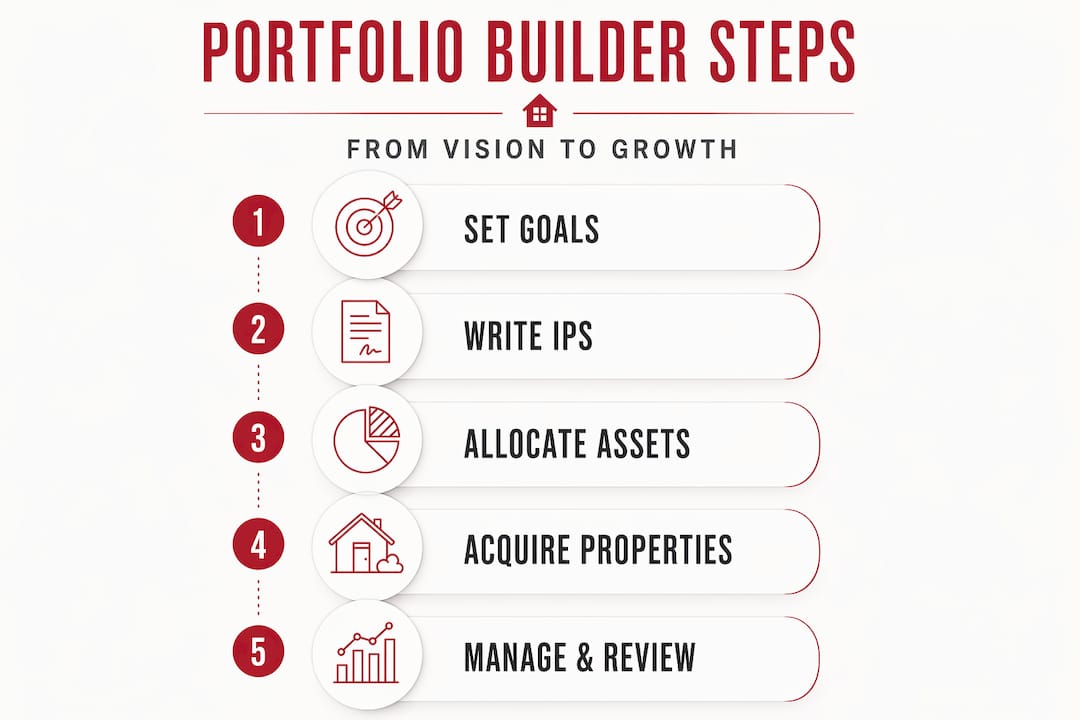
Before you acquire a single property, you need to answer three questions with precision: What do you want this portfolio to do? How much loss can you absorb without changing your behavior? And how much of your capital can be locked up for five or more years?
These are not rhetorical questions. Affluent investors frequently skip this step because they feel the answers are obvious. They are not. A family office targeting multigenerational wealth preservation has entirely different constraints than a high-net-worth entrepreneur reinvesting liquidity events. Luxury real estate portfolios function best when aligned with the investor's legacy goals rather than purely financial metrics.
Here is what you need to define before your first acquisition:
- Investment philosophy. Are you prioritizing income generation, capital appreciation, or wealth transfer to the next generation? Your answer determines which property types and submarkets belong in your portfolio.
- Risk tolerance. This has two layers. Financial risk tolerance is the maximum drawdown you can sustain without impairing your broader financial position. Psychological risk tolerance is how you actually behave when a $4 million property sits vacant for six months.
- Liquidity needs. Luxury real estate is inherently illiquid. Liquidity mismatches cause forced sales and portfolio instability. You need to map out which capital is truly long-term and which you may need access to within three years.
- Time horizon. A 10-year horizon allows you to absorb market cycles. A 3-year horizon severely limits which luxury property categories make sense.
The output of this exercise is an Investment Policy Statement. An IPS must be a dynamic governance tool with measurable return goals, concentration limits, and rebalancing protocols written in. Treat it as a living document you revisit annually or after any major life or market change.
Pro Tip: Write your IPS before you have deal pressure. Once you are looking at a specific property, objectivity disappears. The IPS is your protection against buying the wrong asset for the right emotional reasons.
Strategic asset allocation and acquisition planning
The most disciplined approach to investing in luxury real estate borrows directly from institutional portfolio construction. Family offices structure luxury portfolios using roughly 40% core, 20% value-add, and the remainder in opportunistic assets, with core investments yielding 7 to 10% and value-add targeting 12 to 15%.
Here is how each category functions in practice:
| Category | Risk Level | Typical Return Target | Example Property Type |
|---|---|---|---|
| Core | Low | 7–10% | Stabilized coastal estate, trophy condo |
| Value-add | Medium | 12–15% | Dated luxury home in appreciating submarket |
| Opportunistic | High | 15%+ | Off-market distressed luxury, development site |
Core holdings provide stability and predictable cash flow. Value-add properties require active management but generate superior returns when executed well. Opportunistic plays carry the most risk and should represent a minority of your portfolio, particularly in early stages of building upscale real estate assets.

Geographic diversification matters more than most investors realize. Luxury portfolios often suffer from accidental concentration in headline cities rather than diversified submarkets. Owning three properties in the same coastal zip code is not diversification. It is concentration with a premium price tag.
Submarket-level data analyses provide more accurate risk and return profiles than broad city-level assumptions. Before any acquisition, analyze supply pipelines, days on market, absorption rates, and price per square foot trends at the neighborhood level. The best luxury neighborhoods in any given market can look dramatically different from each other even within the same city.
Market timing is secondary to market selection, but it is not irrelevant. Buying during periods of elevated inventory gives you negotiating leverage that simply does not exist in a seller's market. Patience in acquisition is a skill that separates disciplined portfolio builders from reactive ones.
Pro Tip: When evaluating a new submarket, look at the ratio of luxury listing days on market versus the broader market. A widening gap often signals a softening luxury segment before price data catches up. That lag is your entry window.
Execution tactics: legal structuring, tax, and financing
This is where most investors leave significant money on the table. Execution is not just about finding the right property. It is about owning it correctly, financing it efficiently, and paying the minimum legally required in taxes.
Legal structuring comes first. Separate LLCs for individual properties protect your entire portfolio from a single asset liability event. A legal firewall shields your other assets and preserves portfolio continuity. Using a single entity across multiple luxury properties is a structural error that no amount of insurance fully corrects.
Tax efficiency is not optional. Consider these tools:
- 1031 exchanges. Section 1031 like-kind exchanges allow tax deferral when reinvesting sale proceeds into replacement real estate. You must identify replacement property within 45 days and close within 180 days. Miss either deadline and the tax bill arrives immediately.
- Cost segregation. An engineering-based cost segregation study accelerates depreciation on components like fixtures, landscaping, and specialized systems. On a $5 million luxury property, this can generate hundreds of thousands in accelerated deductions in year one.
- Estate and tax integration. Active integration of investment, tax, and estate strategies improves portfolio efficiency and multigenerational wealth preservation. Fragmented approaches consistently produce tax inefficiencies and missed planning opportunities.
Financing strategy determines your leverage risk. Standard jumbo mortgages work for most core acquisitions. For larger or more complex deals, mezzanine debt enables larger acquisitions while freeing liquidity, though the higher interest cost requires careful analysis. The rule is simple: leverage should enhance returns without creating a liquidity crisis if a property sits vacant or values temporarily decline.
Pro Tip: Run a cost segregation study on every luxury acquisition above $3 million. The upfront cost of the study is typically recovered within the first year through accelerated depreciation benefits.
Portfolio management: rebalancing and risk assessment
Acquiring properties is the exciting part. Managing the portfolio over time is where discipline either compounds your returns or quietly destroys them.
Systematic rebalancing is the most underused tool in luxury real estate portfolio management. Discipline in following rebalancing protocols based on triggers maintains portfolio balance and removes emotion from decisions. Successful portfolios use two types of triggers. Calendar triggers prompt a review on a fixed schedule, typically quarterly or annually. Variance-band triggers activate when any single asset or category drifts beyond a set percentage of your target allocation.
Here is a practical rebalancing process:
- Set target allocation percentages for each property category and geography in your IPS.
- Define variance bands. A common threshold is plus or minus 5% from target before action is required.
- Review portfolio composition quarterly against those targets.
- When a variance band is breached, evaluate whether to sell, acquire, or reweight through new capital deployment.
- Document every rebalancing decision with the rationale. This creates accountability and protects against pattern drift.
Risk monitoring goes beyond gut feel. Value at Risk modeling provides measurable downside metrics that guide hedging decisions and concentration limits. Sophisticated investors set maximum concentration caps per asset, submarket, and property type within their IPS.
Liquidity monitoring deserves its own protocol. Segmenting capital into liquidity sleeves aligned with time horizons enables patient capital deployment and reduces cash drag. Know exactly which properties could be sold within 90 days if needed, which require 6 to 12 months, and which are true long-term holds. That clarity prevents forced sales at the worst possible time.
My perspective on scaling luxury portfolios
I have worked with affluent investors across more than 250 luxury transactions, and I consistently see the same patterns in who succeeds and who stalls.
The investors who struggle almost always underestimate how deeply tax and estate planning need to be integrated from day one. They treat it as something to address after the portfolio is built. That is exactly backwards. The structure you choose on your first acquisition shapes your options on your fifth.
The second pattern I see is accidental concentration. Investors fall in love with a particular city or neighborhood, and before they realize it, 70% of their portfolio is exposed to a single local market. I have watched this create real pain during localized corrections that barely registered nationally. The San Diego luxury market offers genuine submarket diversity, but you still have to pursue it deliberately.
The most counterintuitive lesson I have learned is this: the IPS is not a bureaucratic exercise. It is the single most valuable document in your portfolio. The investors I know who treat it as a living, evolving framework consistently outperform those who write it once and file it away. Markets change. Life circumstances change. Your IPS should reflect both.
Finally, matching liquidity tiers to investment timelines is not a nice-to-have. It is the difference between building wealth and being forced to sell a great asset at a terrible time because you needed capital you should have kept accessible.
— Stu
Work with Stuharveyestates to grow your portfolio
If you are serious about building a high-end property portfolio in Southern California, the quality of your local intelligence matters as much as your capital. Stuharveyestates brings over 15 years of expertise and more than $1.2 billion in luxury transactions to every client relationship. Whether you are evaluating your first acquisition in La Jolla or expanding an existing portfolio into Rancho Santa Fe, the process starts with understanding the right neighborhoods at the submarket level. Browse luxury property listings curated for serious portfolio investors, or explore the neighborhood guides to sharpen your geographic strategy before your next move.
FAQ
What is the first step in building a luxury real estate portfolio?
Define your investment goals, risk tolerance, and liquidity needs before acquiring any property, then formalize those parameters in a written Investment Policy Statement. This governance document prevents emotional decisions and keeps your acquisitions aligned with your actual objectives.
How should I allocate capital across luxury property types?
A proven institutional framework uses roughly 40% in core stable assets, 20% in value-add properties, and the remainder in opportunistic plays. Core assets provide income stability while value-add and opportunistic holdings drive growth.
What is a 1031 exchange and how does it help luxury investors?
A 1031 exchange allows you to defer capital gains taxes by reinvesting sale proceeds into a replacement property. You must identify the replacement within 45 days and close within 180 days, making timeline management critical for luxury transactions.
Why do luxury real estate investors use separate LLCs?
Each property held in its own LLC creates a legal firewall that prevents a liability event on one asset from threatening the rest of your portfolio. It also allows tailored financing structures per property, which adds flexibility as your portfolio grows.
How often should I rebalance a luxury real estate portfolio?
Review your allocation quarterly against your IPS targets, and rebalance whenever any category drifts more than 5% from its target weight. Using both calendar and variance-band triggers removes emotional bias from what should be a systematic process.
